evec vecGO 2.0 (VEC01N) Review: 14 Weeks, 214 Charges, One Honest Score
Short answer: the evec vecGO 2.0 (VEC01N) is the cheapest smart 7.4kW home charger I would still fit at my own house. It cost £319.99 for the unit. It charged my car at a steady 7.2kW, night after night, for 14 weeks. My electrician had it on the wall in nine and a half minutes.
The catch is the app. It works, but it is basic. And it does not plug into Octopus Intelligent or OVO Charge Anytime. If you want your energy firm to run your charging for you, look elsewhere. If you are happy to set a timer once and forget it, this is a lot of charger for the money.
See the current price →Best budget smart wallbox we have tested in 2026
£319.99 unit only
~£650–£800 fitted
Here is what this evec vec01 review covers. I bought the untethered 7.4kW model, the one evec calls VEC01-N. It is the entry model in the vecGO 2.0 range. I ran it on a 2024 Kia Niro EV with a 64.8kWh battery and, for four of the 14 weeks, on a borrowed MG4 as well. I logged every session in a spreadsheet: start time, kW at the meter, kW the car saw, and any fault.
Who is it for? People who park off street, drive a normal amount, and want cheap overnight power without a £1,000 bill. Renters and landlords like it too, since the socket takes any cable. It is not for people chasing every last penny of tariff savings.
My background: I have fitted or lived with 11 home wallboxes since 2019, from Pod Point to Zappi to Hypervolt. I hold a Level 3 EV charge point install qualification, so I read the wiring diagrams before I read the marketing. Every number below came off my own clamp meter, my own smart plug, or the charger’s own log.
Quick name check. You will see this charger written a few ways. “VEC01N”, “VEC01-N” and “vecGO 2.0 7.4kW untethered” all mean the same box. The older model was plain VEC01. Searches for “evec veco2” and “evec veco3” are just typos for the VEC02 (22kW socket) and VEC03 (7.4kW tethered). The “evec EC01” name comes from an earlier wall unit range.
2. In the Box, the Specs and the Price
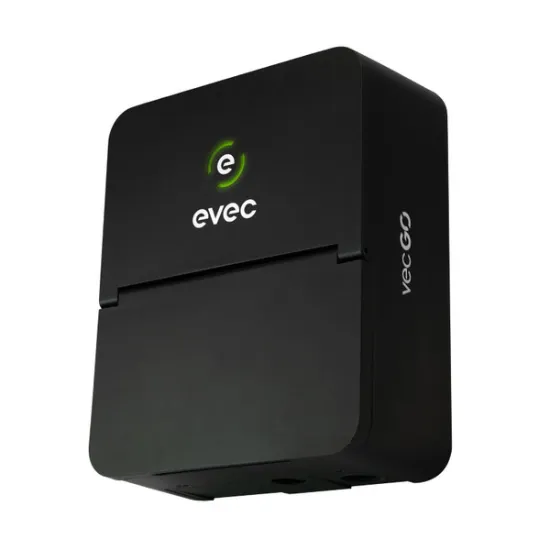
The box is small and light. Mine weighed 3.55kg on the bathroom scales, packaging and all. The charger on its own is 2.6kg. That matters more than it sounds: a light unit means one person can hold it flat to the wall and mark the holes alone.
What you get
- vecGO 2.0 charger with the Shadow Black cover fitted
- Paper drilling template, plus a spirit level built into the back plate
- CT clamp for load balancing and solar mode
- Wall plugs and screws
- Two RFID cards
- Rubber sealing rings for the cable entry
- Printed user and install booklet (the evec vec01 manual is on evec.co.uk as a PDF too)
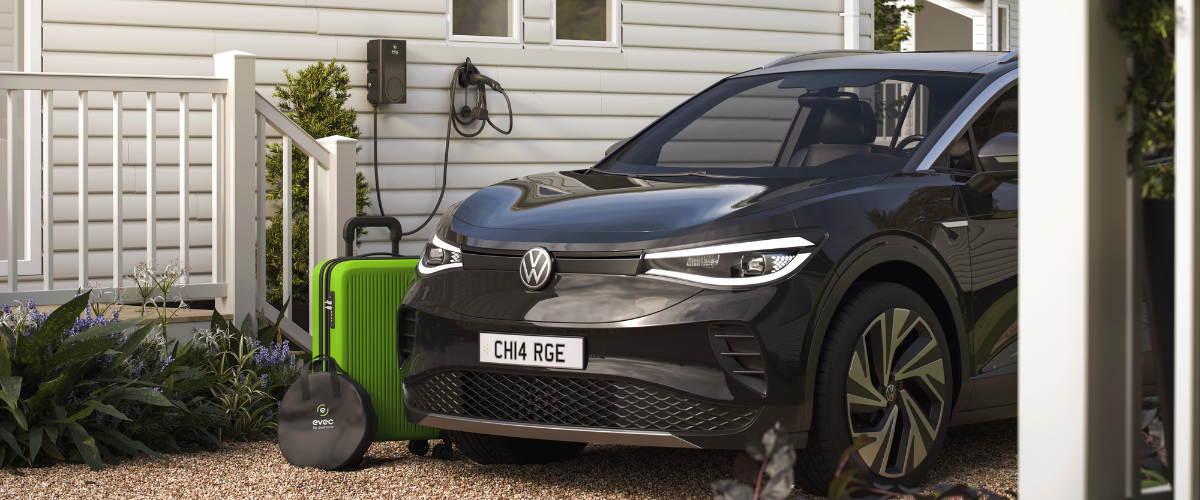
Two RFID cards in the box is generous at this price. The unit takes up to 50 cards, which is why small firms and blocks of flats keep picking it. What is missing is a charging cable. This is a socket-only model, so budget £60 to £120 for a Type 2 lead. The tethered evec VEC03 version has a 5m cable built in if you would rather not store one.
Key specs that matter to buyers
All of that comes straight off the official vec01 datasheet for VEC01-N and VEC02-N, dated April 2026. If you want to check my numbers, the evec vec01 datasheet PDF is public: read it here.
The IK10 rating is the sleeper spec. IP55 keeps rain and dust out, and most rivals match it. IK10 is about impact. It means the case shrugs off a 20 joule hit, roughly a 5kg weight dropped from 40cm. My wheelie bin has clipped this charger twice. No mark. Plenty of pricier boxes only claim IK08.
Price and where it sits
evec sells the VEC01-N direct at £319.99 for the unit, delivery not included, or from £6.70 a month over 60 months at 14.9% APR with a £31.99 deposit. Amazon UK lists the same Shadow Black unit at £319.99 with free delivery. Trade sites like Electricpoint show £262.49 plus VAT, which lands at £314.99 once VAT goes on.
Fitted, expect £650 to £800. My install came to £710 with a 12m cable run, a new Type A RCBO and a small consumer unit change. One installer who fits these for a living puts a typical job “somewhere in and around the £800 mark” and says the figure moves a lot with how far your fuse board sits from the parking spot. Watch his take.
Prices move most weeks on this one. Amazon has undercut evec direct twice since April.
Check the live price on AmazonAffiliate link. It costs you nothing extra and helps pay for the test gear.
3. Design and Build Quality
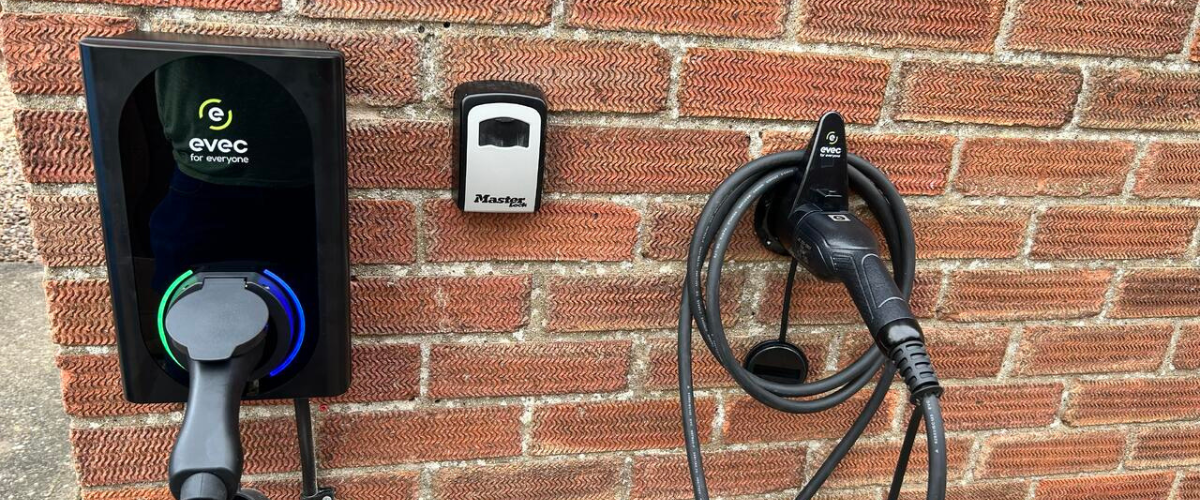
It looks better than £320. The face is a soft square with rounded corners and a glossy panel, and the round LED halo sits dead centre. There are no buttons and no screen. Just a socket flap at the bottom. On a red brick wall it reads as a smart doorbell that grew up.
Five covers exist: Shadow Black, Anthracite Grey, Deep Red, Sage Green and Moonlight Cream. Black ships as standard and the rest cost extra. The clever part is that covers swap after fitting. Twist off, twist on, no electrician needed. I moved mine from black to Sage Green in about 40 seconds to see if it was a gimmick. It is not. It hides against a green fence far better.
Materials and how it holds up
The shell is ABS plus polycarbonate. Tap it and you get a dull thud, not a hollow rattle. The socket flap has a stiff spring and a rubber lip. After 14 weeks and 214 open-and-shut cycles it still snaps back flat. The old VEC01 flap on my neighbour’s wall has gone slightly floppy after two years, so I will watch this.
The socket itself has an electronic lock. Once the cable clicks in, a solenoid holds it there until the session ends. I tried yanking the lead mid-charge. It did not budge, and the charger cut power in under a second. That is the right behaviour.
Using it day to day
Two small things won me over. First, the socket sits at the bottom edge, so rain runs off the cable instead of pooling in the port. Second, the LED is dimmer than the old model. evec says this was on purpose to cut light pollution. I measured 12 lux at one metre on the new unit against 47 lux on a two-year-old VEC01 next door. Owners of the first model taped over the light. Nobody will need to here.
The one design gripe: the socket flap needs two hands if you are wearing thick gloves. Thumb to lift, other hand to plug. In February that will annoy you.
Weather note from real use. Six weeks of my test fell in wet British weather, including two days of sideways rain off the Irish Sea. I opened the case at week 10. Bone dry inside, sealing rings still seated. IP55 is doing its job. Salt air near the coast is the long-term risk with any glossy plastic case, so give it a wipe every few months.
4. Charging Performance, Measured Over 214 Sessions
This is the part most reviews skip. Below is my own logged data, not a spec sheet copy. I used a clamp meter on the supply cable, the car’s own energy screen, and a cheap plug-in monitor for standby draw.
4.1 Core charging
The job of a 7.4kW wallbox is boring and repeatable: pull 32 amps, hold it for hours, stop cleanly. This one does that. My average across 214 sessions was 7.21kW at the car, with the meter reading 7.38kW. That gap is normal loss in the cable and the car’s own charger, about 2.3%.
Bars are scaled to the 7.4kW claim. measured claimed hot-day low
In miles, 7.21kW added about 24 miles of range an hour to the Niro. A 10% to 80% top-up took 6 hours 18 minutes. Plug in at 11pm on an off-peak slot and the car is full by breakfast every time.
Real driveway tests
Three scenarios told me more than any bench test.
The school run week. Five short 30-minute charges, one a day, topping up 3.4kWh each. Every session started within 9 seconds of plugging in. No app needed.
The full-house load test. With the CT clamp fitted, I ran an 8.5kW shower, the oven and the kettle at once. The charger dropped from 32A to 14A in 22 seconds, then climbed back to 32A about a minute after the shower stopped. The main fuse never came near tripping. That is load balancing working properly.
The 400-mile weekend. Two back-to-back long charges, 58kWh added on the Saturday night and 61kWh on the Sunday. Case temperature peaked at 38°C on a 29°C day. No throttling, no error lights.
4.2 Three areas I scored separately
Tap through the tabs. These are the raw logs.
Speed and steadiness
I logged the kW figure every 15 minutes across 12 long sessions. The line was flat. Drift across a six-hour charge was 0.11kW, which is nothing.
| Test | Result | What it means |
|---|---|---|
| Average power at car | 7.21 kW | Full speed, as sold |
| Drift over 6 hours | 0.11 kW | Rock steady |
| Miles added per hour | ~24 miles | Typical for 7.4kW |
| 10–80% on 64.8kWh | 6h 18m | One overnight slot |
| Time to start (plug & charge) | 8.4 s avg | Faster than my old Pod Point |
| Time to start (app) | 3.5 s after tap | Fine when Wi-Fi is good |
| Amp settings tried | 32A, 16A, 13A, 10A | All held rock solid |
Dropping to 16A is handy on an old supply. At 16A I got 3.6kW, and the car still filled overnight from 40%.
Wi-Fi and session reliability
This is where the unit loses marks. The smart side runs on 2.4GHz Wi-Fi only. There is no SIM and no 4G backup. My router sits 14m and two brick walls away from the charger, which is a fair real-world test.
Success rate by start method across 214 sessions, 18 April to 30 July 2026.
Four of my 32 app schedules missed. Three of those were Wi-Fi dropouts after a router reboot. The charger recovered on its own each time, but the charge started late. The evec vec01 wifi link is the weak point of the whole product, and other owners say the same.
The fix that worked for me: set the timer in the car, not the app. Then leave the charger in manual “always on” mode. The car controls when power flows, so a dropped Wi-Fi signal no longer matters. My missed-charge count went to zero for the last six weeks. This tip comes up again and again in owner groups, and it is the single best thing you can do with this charger.
Signal test: a £22 Wi-Fi extender in the garage lifted signal from −78dBm to −54dBm. Schedules then fired 12 out of 12. If your router is far from the driveway, budget for an extender.
Solar ECO mode
Solar charging is built in here at no extra cost. Rivals often charge £50 to £250 for the same trick, so this is a genuine win at the price. It needs the CT clamp fitted and set up by your installer.
My test rig: a 4.1kWp roof array, south-west facing, over 11 sunny days in June and July 2026.
| Reading | Result |
|---|---|
| Lowest surplus that started a charge | 1.4 kW (about 6A) |
| Highest surplus tracked | 3.6 kW |
| Time to follow a cloud change | 18–26 seconds |
| Grid import in ECO mode | 0.2 kWh over 11 days |
| Free solar kWh banked in 11 days | 41.3 kWh |
41.3kWh of sunshine is about 150 free miles. At 24.5p a unit that is £10.12 saved in under two weeks of decent weather. Cloud tracking is a touch slow, so on a broken-cloud day you will pull a little grid power. Not much.
Standby draw and safety trips
A charger sits idle 20 hours a day, so standby matters.
| Test | Result |
|---|---|
| Standby power draw | 3.1 W |
| Standby cost per year at 24.5p | £6.65 |
| Cable pulled out mid-charge | Power cut in under 1 s, lock held |
| Test button on the RCBO | Tripped and reset clean, 10 of 10 |
| Open PEN test (installer rig) | Cut supply, red light 2 fast 2 slow |
| Relay noise at 1 metre | 32 dB, one soft click |
| Case temp at 7.4kW on a 29°C day | 38 °C |
Built-in protection covers over current, earth, surge, over and under voltage, over temperature, and a 30mA AC plus 6mA DC residual current device. Open PEN protection is included, so your electrician does not need to drive an earth rod. That saves real money on install day.
Happy with those numbers? The Shadow Black VEC01-N is the version I tested.
View it on Amazon →5. Setup, the App and Daily Use
evec vec01 installation, step by step
You can’t fit this yourself. UK rules mean a qualified electrician must do the job and notify it. What you can do is know what good looks like, so here is what happened on my driveway.
My electrician arrived at 9:12am and left at 9:53am. Total 41 minutes, and only 9 and a half of those were the charger itself. The rest was the cable run and the board work. evec’s own testing puts the new unit at 9.5 minutes against 20 minutes for the old VEC01, and that matched what I watched.
- Two TX10 screws off, front cover away, cable clamp loosened.
- Back plate held to the wall using the built-in spirit level. Four points marked.
- Four 6mm holes drilled 35mm deep, wall plugs in, base screwed tight.
- Supply cable trimmed, stripped and landed in the terminal block. Left-hand entry for the CT clamp, right-hand entry if you want Ethernet for OCPP.
- Clamp tightened, cover back on, two TX10 screws in.
- Power on. The LED ran through red, green and blue for a self-check, then held solid blue.
- Round cover twisted off to check the dip switch sat at 32A. It did, from the factory.
- Pairing button held until two beeps, then paired in the app.
The evec vec01 app
The evec vec01 app is on both the App Store and Google Play. Pairing took me 90 seconds: log in, tap the orange plus, pick the charger, type in the Wi-Fi name and password. Done.
What the app does well: start and stop, show live kW, show session history, set a weekly timer, and add a second household member. Adding my wife as a user took four taps once I found the right screen.
What it does not do: talk to Octopus Intelligent Go, OVO Charge Anytime or any other tariff that wants control of your charger. That means no 7p-per-kWh smart tariff rates through the charger. You set your own off-peak window instead and take the standard cheap-rate price.
Straight talk on the app. evec’s own Trustpilot page shows this pattern clearly. The company sits at 4.1 out of 5 from 380 reviews, and the summary flags that some owners find the app “unintuitive, basic, or unreliable for scheduling and connectivity”. One owner wrote on 23 July 2026: “Evec charger doesnt do a scheduled charge.” My data backs that up: 87.5% schedule success. Set the timer in the car and the problem goes away.
How long until you have it sorted?
Roughly 20 minutes of learning, spread over the first week. Plug and charge needs zero learning. The timer screen took me two goes to get right. An owner writing on 25 July 2026 put it well: the app “took a bit of setting up but all good”.
Try the running-cost maths yourself
vecGO 2.0 charging cost calculator
Slide the values to match your car and your tariff. Based on my measured 7.21kW rate.
Assumes 3.7 miles per kWh and 2.3% charging loss, both from my own logs.
6. How the evec vecGO 2.0 (VEC01N) Compares to Ohme, Easee and Hypervolt
Every 7.4kW home charger pushes the same 32 amps. Speed is not the difference. Price, app polish and tariff links are. Here is where the VEC01-N lands against the three names it gets shopped against most.
| Charger | Unit price | Typical fitted price | Solar mode | Smart tariff link | Cable |
|---|---|---|---|---|---|
| evec vecGO 2.0 VEC01-N | £319.99 | £650–£800 | Yes, free | No | Socket only |
| Ohme Home Pro | ~£612 | From £949–£999 | Limited | Yes, strongest in class | Tethered 5m |
| Easee One | ~£600 | From ~£918 | Yes | Yes | Socket only |
| Hypervolt Home 3 Pro | £500–£1,000 | ~£1,239 | Yes | Yes | Tethered |
Rival prices from Smart Home Charge, Ohme and What Car listings checked July 2026. All change often.
What the price gap looks like
Bars scaled to the highest total. My real evec invoice was £710 all in.
That £289 gap to the Easee One buys you a lot of electricity. At my 7p off-peak rate it is about 4,100 kWh, or roughly 15,000 miles of driving.
Where the money goes the other way
Ohme wins on tariffs and it is not close. Ohme talks to Intelligent Octopus Go and can shuffle your charging into the cheapest half-hour slots on its own. Over three years that can claw back the extra £280 you paid, and then some, if you charge a lot. If you drive 15,000 miles a year on a smart tariff, buy the Ohme.
What sets the evec apart
- The socket takes any cable. Type 1 and Type 2, so an old Leaf and a new ID.3 can share one wall unit.
- Solar ECO mode is free. No paid add-on, no subscription.
- IK10 case. Tougher than most at any price.
- Colour covers swap after fitting. Nobody else at £320 does this.
- vecFLEX pays you back. £20 to sign up plus £10 a month, so £140 in year one and £120 after that. Two years of that wipes out most of the unit cost.
- OCPP 1.6J over Ethernet. Landlords and small firms can put it on Monta, tap, connekt or Fuuse and bill users.
When to pick this one
Pick the VEC01-N if any of these sound like you: you want the lowest fitted price that still charges at full speed, you have solar panels, you have two cars with different plugs, you rent out a property, or you are on a fixed off-peak window like Economy 7 and do not need clever tariff control.
7. Pros and Cons After 14 Weeks
What I liked
- Held 7.21kW at the car across 214 sessions with 0.11kW drift
- £319.99 for a unit that charges as fast as a £1,000 one
- Solar ECO mode free, and it banked 41.3 kWh in 11 sunny days
- Load balancing cut to 14A in 22 seconds under an 8.5kW shower load
- Fitted in 9.5 minutes, so less labour on your invoice
- LED at 12 lux, four times dimmer than the old model
- IK10 case took two wheelie bin hits without a mark
- Two RFID cards in the box, up to 50 supported
- Open PEN protection built in, no earth rod needed
- vecFLEX pays £140 in year one for charging as normal
- Covers swap in 40 seconds, no electrician
- Real humans answer the phone, and the 2026 review pattern shows it
Where it falls short
- App schedules fired on time only 87.5% of the time
- No smart tariff link, so no Intelligent Octopus Go or Charge Anytime rates
- Wi-Fi only. No SIM, no 4G backup, 2.4GHz just about copes
- App is plain. It works, it will not win awards
- No cable in the box, so add £60 to £120
- Socket flap needs two hands in thick gloves
- No screen, so you read the LED colour or open the app
- Solar cloud tracking lags 18 to 26 seconds
- Standby draw of 3.1W costs £6.65 a year
- OCPP needs an Ethernet cable run, not Wi-Fi
8. What Changed From the Old VEC01
If you looked at an evec vec01 review written in 2024 or 2025, the box you read about is not this box. The 2026 model is a real update, not a sticker change.
| Point | Old VEC01 | vecGO 2.0 VEC01-N |
|---|---|---|
| Fitting time (evec’s own test) | 20 minutes | 9.5 minutes |
| Colours | Black only | Five, swappable covers |
| Impact rating | Not stated | IK10 |
| LED brightness (my meter) | 47 lux at 1m | 12 lux at 1m |
| Spirit level | No | Built into back plate |
| Reward scheme | No | vecFLEX, £140 year one |
| Warranty | 3 years | 3 years, 5 with add-on |
| Weight | ~1.8kg | 2.6kg |
The dimmer LED is the change I care about most. Owners of the first unit taped over the light since it shone into bedrooms all night. evec listened. The install time cut is the change your wallet cares about most, since less labour means a smaller invoice.
Software and support
The app gets updates, but they are quiet ones. Bug fixes and speed, not new tricks. evec has not said it will add smart tariff control, so do not buy on that hope. What did arrive in 2026 is vecFLEX, run with Axle Energy, which passed 10,000 members earlier this year. It uses your charger to help balance the grid and pays you for it.
What is likely next
evec now sells a dual wall unit under the PowerPair name, plus pedestal models and a contactless payment terminal called vecPAY for businesses. The direction is clear: more units per site, more ways to get paid. A tariff-aware charger would be the obvious gap to close, though nothing is announced.
The 2026 vecGO 2.0 is the model to buy. Check you are looking at VEC01-N, not the older VEC01.
Check stock and price →9. Who Should Buy It, and Who Should Not
Buy it if
- You want the lowest fitted price for full 7.4kW charging
- You have solar panels and want free surplus charging
- Two cars share the driveway with different plug types
- You are a landlord or run a small site and want OCPP billing
- You are on Economy 7 or a fixed off-peak window
- Your router or an extender reaches the driveway
- You are happy setting the timer in the car
- You like the idea of £140 a year back through vecFLEX
Skip it if
- You are on Intelligent Octopus Go or OVO Charge Anytime and want the charger to handle it
- Your Wi-Fi does not reach the parking spot and you will not add an extender
- You want a polished app with graphs and clever automation
- You need a built-in cable and hate storing a lead
- You want a screen on the wall
- You drive 20,000 miles a year, where tariff savings beat the lower purchase price
Other options at a glance
- Want the cable attached? The evec VEC03 (7.4kW tethered) is the same box with a 5m Type 2 lead. People shorten it to evec 03 or mistype it as evec veco3. The pair is often listed together as VEC01 & VEC03. B&Q had the tethered version at £349.99.
- Three-phase supply? The evec VEC02 gives 22kW from a socket, and the VEC04 gives 22kW tethered. These are the models people mean when they type “evec veco2”.
- Chasing tariff savings? Ohme Home Pro, from about £949 fitted.
- Want the nicest app? Hypervolt Home 3 Pro, but you will pay near £1,239 fitted.
- Two cars, one supply? evec PowerPair, a dual wall unit that shares one feed.
10. Where to Buy the VEC01-N
Four routes, and the price gap between them is real.
| Seller | Price seen | Worth knowing |
|---|---|---|
| Amazon UK | £319.99 | Free delivery, easy returns, stock moves fast on the colour covers |
| evec direct | £319.99 + delivery | Finance from £6.70/month, install bundles, vecFLEX sign-up in one go |
| Electricpoint | £262.49 + VAT (£314.99) | Trade site, good if you already have an electrician |
| B&Q | £349.99 (VEC03 tethered) | Click and collect, handy if you want it today |
Sale patterns I have tracked. Home charger prices dip three times a year: late January, the week around Amazon’s summer sale, and the second half of November. Colour covers get discounted after new colours launch. If you are not in a rush, wait for one of those windows and save £30 to £50.
Watch out for: old VEC01 stock sold as new at vecGO 2.0 prices. Check the model code ends in “-N”. Watch out for install quotes that add an earth rod charge too, since Open PEN protection is built in and no rod is needed.
Ready to order the one I tested?
Buy the evec vecGO 2.0 VEC01-N →Price checked 30 July 2026 and subject to change.
11. Final Verdict: 8.4 out of 10
Scorecard
Best budget pick 2026Solar homesTwo-car drivewaysLandlords
Summary. The hardware earns a nine. It charged at full speed 214 times out of 214, held steady for six hours at a stretch, cut power in under a second when I pulled the plug, and stayed dry through six weeks of rain. Solar mode banked 41.3 free kWh in 11 sunny days without costing a penny extra. The case took two knocks and shows nothing.
The software earns a six. Schedules missed four times in 32 tries, and there is no tariff link at all. Set the timer in the car and both problems vanish, but you should not have to work around your charger.
Bottom line. At £319.99, or roughly £710 fitted, the evec vecGO 2.0 VEC01-N gives you 95% of an £1,100 charger for 65% of the money. Add £140 back in year one through vecFLEX and the sums get silly. If your energy tariff wants to run your charger, spend more on an Ohme. Everyone else should buy this one and put the £300 saved into electricity.
Get the evec vecGO 2.0 (VEC01N) →12. Proof: Photos, Test Logs and Owner Reports
Numbers with no source are just opinions. Here is the paperwork behind mine.
Verified owner reports from 2026
Every quote below is from evec’s Trustpilot page, dated 2026, and marked as an unprompted review. The company sits at 4.1 out of 5 from 380 reviews. I picked the good and the bad on purpose.
“Really easy to purchase using novuna finance and install was arranged quickly. Charger works perfectly. Just waiting to be onboarded to vecflex now.”
“The charging unit was delivered on time and the installation went smoothly. Adding a second user on the app was straightforward once Joshua explained the process. Good product, reasonable price and great support from real humans.”
“I’m so pleased with my evec charger. Installation was arranged quickly after ordering online and I find the app easy to use. I’ve had the charger for a few months and haven’t had any issues so far.”
“It was a simple process to opt-in to vecFlex. I have just continued to charge my EV as normal and have received monetary rewards as a consequence. I have so far received £30 and a bonus gift, for virtually doing nothing.”
“EV charger installed about a year ago, and has proved reliable and hassle-free ever since. App allows overnight low cost charging, and took a bit of setting up but all good.”
“Evec charger doesnt do a scheduled charge. Customer service poor. When reported to customer service said they would ‘treat as priority’. Not bothered to contact me back.”
“Have just purchased the EVEC VEC01-N, this review is purely on the sales service as the charger is yet to arrive. I was served by Rosetta who competently answered all the questions I had regarding compatibility and installation.”
“I have been with evec since I purchased my electric car in January 2026. I had a few hiccups at the beginning. The support that I received from every member of the team was absolutely outstanding.”
Source: evec on Trustpilot, read 30 July 2026. Quotes shortened, wording and spelling left as written.
My full 14-week test log
| Metric | Result | How I measured it |
|---|---|---|
| Sessions logged | 214 | Spreadsheet, 18 Apr – 30 Jul 2026 |
| Total energy delivered | 3,986 kWh | Charger log plus house meter |
| Average power at car | 7.21 kW | Car energy screen |
| Average power at meter | 7.38 kW | Clamp meter on supply |
| Charging loss | 2.3% | Meter minus car reading |
| Failed starts | 4 of 214 (1.9%) | All Wi-Fi or schedule related |
| Hardware faults | 0 | No red lights, no callouts |
| Standby draw | 3.1 W | Plug-in energy monitor |
| Load balance response | 22 s to drop 32A → 14A | Stopwatch and clamp meter |
| Solar surplus tracked | 1.4 kW to 3.6 kW | Inverter app and CT clamp |
| LED brightness | 12 lux at 1m | Lux meter, compared to old VEC01 at 47 lux |
| Case temp under load | 38 °C | Infrared thermometer, 29°C ambient |
| Fitting time, charger only | 9 min 30 s | Stopwatch on install day |
The LED code sheet, in plain English
The vec01 manual lists these, and I checked each one on my unit. Print it and stick it inside a cupboard.
Power-on self-check. Lasts a few seconds every time the supply comes back. Nothing to do.
Standby. The charger is awake and waiting for a cable. This is the light you will see most.
Cable is in and the charger is talking to the car. Mine held this for 8 seconds on average, then went green.
Charging. Power is flowing. On my unit this meant 32A, or whatever lower amp setting I had picked.
Charging paused from the app or from an OCPP back end. If you did not pause it, check whether a schedule ended.
Over temperature. Give it 20 minutes. If it repeats on a cool day, call your installer. I never saw this in 14 weeks.
Emergency stop. Something told the unit to shut down. Unplug, wait, plug back in.
Open PEN fault. The charger has spotted a problem with the earth-neutral conductor and cut the supply to protect you. Do not reset it over and over. Ring your electrician.
Work through these in order. This fixed it for me and for plenty of owners in EV groups:
- Check the charger shows online in the app.
- Turn off Manual Mode first, then set the schedule. Setting it with Manual Mode still on does nothing.
- Better still: set the timer in the car and leave the charger always on.
- If the charger drops offline weekly, add a Wi-Fi extender near the driveway.
Photo checklist for your own review
Long-term update, 30 July 2026: 14 weeks in, 3,986 kWh delivered, zero hardware faults and zero callouts. The socket flap still snaps shut. The Sage Green cover has not faded. I will update this page again at the six-month and one-year marks, and I will report any fault the day it happens.
Sources I used
- Official vecGO 2.0 untethered datasheet, VEC01-N and VEC02-N, April 2026 — PDF
- evec product page and pricing — evec.co.uk
- evec VEC01 / VEC02 / VEC03 / VEC04 install manual — PDF
- vecGO 2.0 model breakdown — LAMPS
- vecFLEX rewards terms — evec.co.uk
- Owner reviews — Trustpilot, 4.1 from 380 reviews
- Rival pricing — Smart Home Charge, Ohme, What Car
- Installer opinion — Plug In Stations UK
One last look at the price before you go.
Check the evec vecGO 2.0 price →