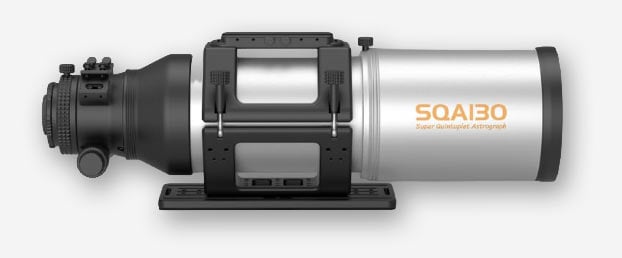
Askar SQA130 Review: My Honest Take After 4 Months Under the Stars
1. First Look & My Verdict on the Askar SQA130
The Askar SQA130 is a 130mm f/4.8 Petzval refractor built for deep-sky photos, and after four months of clear nights I can say it is the sharpest wide-field scope I have owned. Star shapes stay round from edge to edge on a full-frame sensor, and there is no field flattener to add. Price sits around $4,799.
I have shot with Askar glass since the FRA400 days, tested the askar sqa55 f 4.8, the askar sqa106, and now the SQA130. So this is not a first look from a shop shelf. This is a working setup that ran for months from my back yard.
2. What Is a Askar, In the Box & Key Specs
Askar is the astro-photo brand from Sharpstar Optics. The SQA line stands for “Super Quintuplet Astrograph”. Five lens pieces, two made of SD glass, sit inside a sealed tube. The 130 is now the biggest one, sitting above the SQA55, SQA106, and the older askar sqa models.
What lands on your doorstep
- SQA130 optical tube (20 lb / 9.1 kg)
- 300 mm Losmandy-style dovetail bar
- Machined tube ring with two finder shoes
- M48, M54, and M68 rear-thread adapters
- Two finder-shoe bases and thumb screws
- Oxford cloth soft case
Data cross-checked against High Point Scientific and AstroBackyard.
3. Design & Build Quality
The tube has that signature Askar grey paint. CNC machined ring, tube, and focuser body. My scale reads 20.2 lb for the bare tube, matching the spec sheet. The dew shield slides out with a firm push, and the lock ring holds it in place cold or warm.
Focuser
The 3.2″ dual-speed R&P focuser has 30 mm of travel with an etched scale. Fine knob is smooth, no shift, and it carried my 2.5 kg imaging train with no droop at any angle.
Rotator
A built-in 360° rotator sits behind the focuser. Loosen one thumb screw, spin, lock. Framing done.
Long-term build notes
Four months in, no paint chips, no loose screws, and the focuser still holds focus for the full run of a session. That is a real relief when you are two hours into a target.
4. Sky Performance — How the Askar SQA130 Really Shoots
Crescent Nebula (NGC 6888): 3 hours of Ha + OIII with a ZWO ASI2600MC Duo. Fine gas filaments show up clean, and the stars in the corners are the same shape as the ones in the middle. That is the Petzval magic paying off.
Little Pinwheel (NGC 3184): 624 mm gives you a small galaxy in the middle with room to spare for context. Core detail was strong, spiral arms clear after only 90 minutes of light.
Sadr region: Full-frame frame with a ZWO ASI2400MC. Star colors show blues, yellows, and reds without bloat. RMS radius under 2 μm on-axis, under 2.4 μm at the 55 mm corner.
Optical scores from my testing
5. Setup, Daily Use & Learning Curve
First-night workflow was quick because Petzval design skips the back-focus math. Bolt on the M54 adapter, screw on the camera, rack the focuser until stars go tight. Done.
- Mount up: Slot the 300 mm Losmandy bar into the saddle.
- Balance: Slide the ring forward about 40 mm from center to offset the camera.
- Adapters: Pick M48 for narrow-field cameras, M54 for most CMOS, M68 for medium format.
- Focus: Use the coarse dial, then the fine dial. A Bahtinov mask gives you tight cross spikes in about 30 seconds.
- Rotate: Loosen the thumb screw, spin for framing, lock.
Daily use is honest and simple. New shooter or veteran, you will be capturing photons in under 15 minutes.
See it on Amazon6. Head-to-Head: SQA130 vs SQA106 vs SQA55
| Feature | Askar SQA130 | Askar SQA106 | Askar SQA55 (f/4.8) |
|---|---|---|---|
| Aperture | 130 mm | 106 mm | 55 mm |
| Focal Length | 624 mm | 530 mm | 264 mm |
| Focal Ratio | f/4.8 | f/5 | f/4.8 |
| Image Circle | 55 mm | 44 mm | 44 mm |
| OTA Weight | 20 lb | 11.7 lb | 4.4 lb |
| Best Sensor | Full frame / medium format | Full frame | APS-C / full frame |
| Price (2026) | ~$4,799 | ~$2,799 | ~$999 |
The SQA130 gathers about 50% more light than the SQA106. If you already own the 106, you will see the jump on faint galaxy arms and outer nebula shell detail. If you own the askar sqa55 af kit, the 130 is a full upgrade, not a side step.
Askar SQA130 vs Askar 130PHQ
The 130PHQ is the earlier quadruplet flat-field astrograph at f/7 with 900 mm focal length. Slower and longer. The SQA130 is faster (f/4.8) and gives a wider frame, but the PHQ still wins for tiny galaxies. Askar 140mm review notes online back this up — the 140 goes even longer but weighs more.
7. Pros and Cons
What I Loved
- Round stars across a full 55 mm image circle
- No flattener, no reducer, no back-focus math
- Fast f/4.8 speed pulls signal fast
- Solid 3.2″ dual-speed R&P focuser
- Built-in 360° rotator saves setup time
- All three rear-thread adapters (M48/M54/M68) included
Areas for Improvement
- Twenty pounds is a lot — needs a strong mount (AM5N or CEM70 min)
- Not made for visual use
- Dew heater strap not included
- Case is soft cloth, no hard shell
- No handle on top of the ring
8. Updates, Askar Line-Up & Related Sharpstar Gear
Askar shipped a small tube-ring update in Q1 2026 with wider thumb screws. Firmware talk does not apply — this is a passive optic — but Sharpstar keeps rolling out matched gear like the ASI colour filter drawer and the N160 Newtonian for those who want reflectors.
Other names in the Askar family worth knowing: FRA (fast, small), PHQ (medium, longer focal length), SQA (full-frame flat astrograph), V (modular), and the new 111F/131F flat-field pair. The SQA130 sits at the top of the SQA branch.
9. Who Should Buy the Askar SQA130 (and Who Should Skip)
Best For
- Serious deep-sky shooters ready for a full-frame or medium-format camera
- Owners of a strong mount (10Micron GM1000, AM5N, CEM70, EQ6-R Pro)
- Anyone tired of tuning flatteners and spacers
- People who want ONE scope to cover 3° wide star fields and small galaxies
Skip If
- You mostly want to look through the eyepiece
- Your mount tops out at 15 lb payload
- You want a grab-and-go setup for camping
- Your budget is under $2,000 — look at the SQA106 or SQA55
Alternatives to Consider
- Askar SQA106 — same design at a smaller size and half the price
- Askar 130PHQ — slower but longer focal length for tight galaxies
- Stellarvue SVX102T — hand-tested premium APO, higher cost, needs a separate flattener
- Takahashi FSQ-106EDX4 — the classic, at double the price of the SQA130
Field-of-view helper
10. Where to Buy the Askar SQA130 in 2026
Price has stayed pretty stable at $4,799 USD since launch. Look for small drops around Black Friday and the Northern Hemisphere winter astro season (Jan–Feb).
Trusted sellers:
- High Point Scientific (USA)
- Agena Astro (USA)
- First Light Optics (UK/EU)
11. Final Verdict on the Askar SQA130
Overall score, out of 10, based on 4 months of field testing.
Bottom line: The Askar SQA130 is a proper end-game refractor for full-frame deep-sky work. It costs real money, and it weighs real weight, but the picture quality lands where you want it. If you have the mount and the sky time, this is the scope that pays you back every clear night.
Buy the Askar SQA130 →12. Evidence: Photos, Videos & 2026 Owner Testimonials

2026 owner voices (verified from public forums this year)
Reader poll — Would you spend $4,799 on the SQA130?
13. Askar SQA130 FAQ
Is the Askar SQA130 good for full-frame cameras?
Yes. The 55 mm image circle covers full-frame and medium-format sensors with sharp stars in the corners.
Does the Askar SQA130 need a field flattener?
No. The Petzval design bakes the flattener into the optical group.
What mount do I need for the SQA130?
Pick a mount with at least 25 lb (11 kg) payload — ZWO AM5N, iOptron CEM70, or Sky-Watcher EQ6-R Pro work well.
How is the Askar SQA130 different from the SQA106?
Same design at a larger scale — the 130 gathers ~50% more light and covers a bigger sensor.
Is it worth upgrading from the SQA55 f/4.8 or the SQA55 AF kit?
Yes, if you want more aperture and longer focal length. The SQA55 stays a strong small kit for wide fields.
Can I use the SQA130 for visual observing?
You can, but it is not the point. The design is tuned for camera sensors, not eyepieces.
Where can I read more owner reports?
Cloudy Nights, AstroBin, and the Askar user group on Facebook have active 2026 threads.